API 610 Centrifugal Pump Selection Guide: OH2 vs BB3 vs BB5 for Boiler Feed Service
Structural architectures, bearing configurations, thermal growth handling, hydraulic axial balance, and casing pressure containment up to 250 bar.
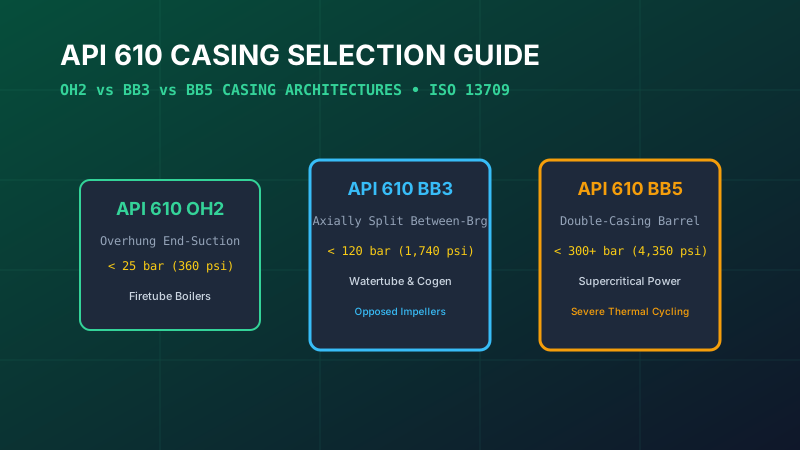
Table of Contents
Selecting the proper pump mechanical architecture is the most enduring decision made during the design of a boiler feedwater system. A mechanical casing improperly matched to system pressure, operating temperature, or cyclic thermal ramping will suffer chronic flange leaks, premature bearing destruction, and shaft fatigue failures.
1. API 610 Standard Scope & Reliability Mandate
The American Petroleum Institute standard API 610 (ISO 13709): "Centrifugal Pumps for Petroleum, Petrochemical and Natural Gas Industries" represents the premier global benchmark for heavy-duty, high-reliability rotating machinery. For boiler feedwater service, API 610 establishes rigorous mechanical requirements:
- Minimum 20-year design operating life and minimum 3 years of uninterrupted continuous operation.
- Centerline casing support for all services operating above 150°C (300°F) to prevent thermal misalignment.
- Rigid shaft design where the first lateral wet critical rotor speed is at least 20% above maximum operating speed.
- API 682 cartridge mechanical seal chambers accommodating standardized flush plans.
2. Type OH2: Centerline-Mounted Overhung Pumps
API 610 Type OH2 is a single-stage, overhung, radially-split casing pump with a dedicated bearing housing and centerline support pedestals:
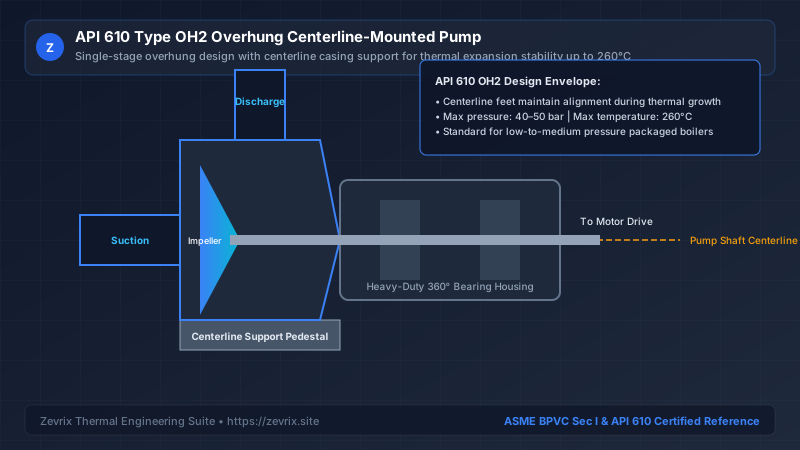
Key OH2 Design Attributes:
- Maximum Discharge Pressure: Typically 40 to 50 bar(g) (580 to 725 psi).
- Maximum Operating Temperature: Up to 260°C (500°F) with centerline mounting.
- Maintenance Advantage: Back-pull-out architecture permits removal of the bearing frame and impeller without disconnecting suction or discharge piping.
- Boiler Application: Industrial package firetube boilers, low-pressure heat recovery steam generators (HRSG LP circuits), and auxiliary steam services.
3. Type BB3: Axially-Split Multistage Opposed Impellers
When discharge pressure exceeds 40 bar, multistage pumps become mandatory. The API 610 Type BB3 is an axially-split (horizontally-split), between-bearings multistage pump featuring impellers mounted back-to-back in an opposed layout:
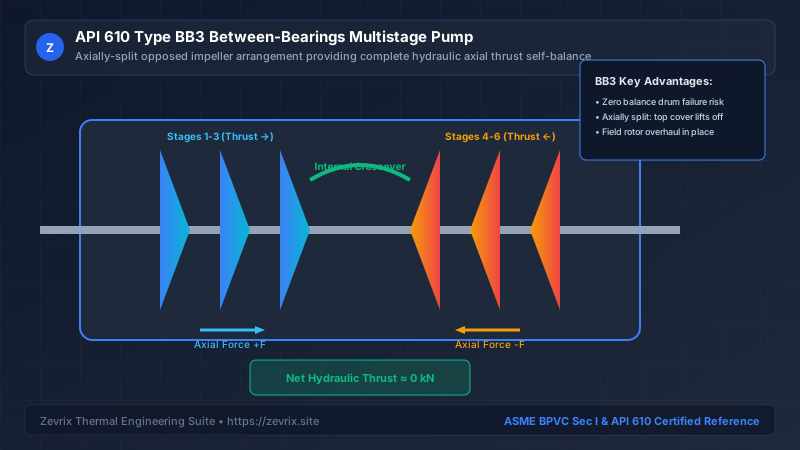
Key BB3 Design Attributes:
- Self-Balancing Axial Thrust: Opposed impeller configuration cancels hydraulic thrust forces, completely eliminating the need for a high-maintenance balance drum.
- Ease of Overhaul: The horizontal split casing allows the top half of the pump to be unbolted and lifted away, exposing the entire rotor for inspection without disconnecting piping nozzles.
- Maximum Pressure Limit: Typically 120 to 150 bar(g) (1,740 to 2,175 psi). Above 150 bar, internal hydraulic pressure can bow the horizontal split flange, causing high-pressure interstage leakage.
- Boiler Application: Cogeneration plants, medium-to-high pressure industrial watertube boilers, and combined-cycle power station main feed pumps.
4. Type BB5: Radially-Split Double-Casing Barrel Pumps
For extreme pressures, supercritical cycles, or rapid thermal transient ramping, the API 610 Type BB5 double-casing barrel pump represents the pinnacle of hydraulic engineering:
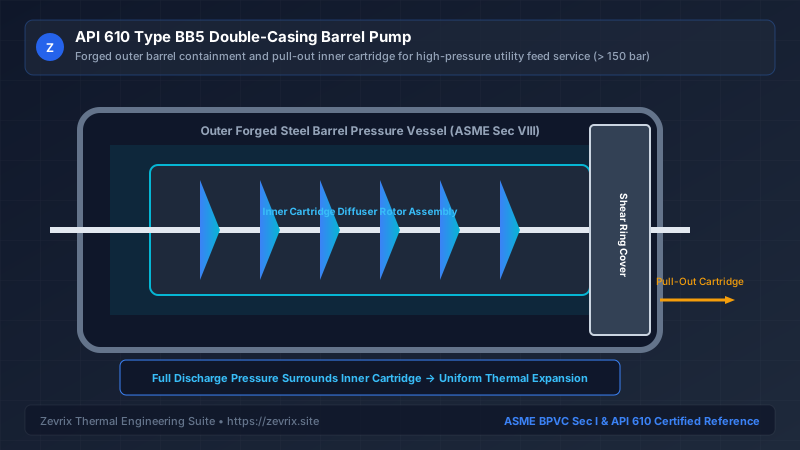
Key BB5 Design Attributes:
- Radially-Split Geometry: Circular radial joints under high pressure are inherently self-tightening, withstanding pressures up to 300+ bar(g) without risk of flange distortion.
- Uniform Thermal Symmetry: Full pump discharge pressure fills the annular space between the inner cartridge and outer barrel, ensuring that the inner casing is uniformly compressed and heated from all directions.
- Thermal Shock Resistance: Capable of withstanding rapid cold-start ramping and thermal shocks exceeding 50°C/minute without binding internal clearances.
- Cartridge Pull-Out: The entire internal multistage rotor and diffuser assembly can be extracted as a single pre-aligned cartridge without cutting the welded main piping.
5. Hydraulic Axial Thrust: Balance Drums vs Opposed Stages
Multistage feed pumps generate tremendous hydraulic axial thrust forces (often exceeding 50 to 100 kN) acting toward the suction nozzle. Controlling this force determines bearing longevity:
| Thrust Balance Mechanism | Mechanical Implementation | Energy Efficiency Impact | Reliability & Failure Mode |
|---|---|---|---|
| In-Line Stages with Balance Drum (BB5 / BB2) | Cylindrical balance piston/drum bleeding high pressure back to suction | Continuous parasitic internal leak (2% to 4% of total pump flow) | Vulnerable to clearance wear; drum seizure causes immediate thrust bearing burnout |
| Opposed Impeller Banks (BB3 / BB5 opposed) | Stages face opposite directions; internal crossover channel | No parasitic balance drum leakage; 100% flow delivered to boiler | Near-zero net axial load; thrust bearing operates in lightly loaded safety zone |
6. Engineering Selection Decision Matrix
| Plant Operating Condition | Recommended API 610 Type | Casing Metallurgy | Primary Engineering Justification |
|---|---|---|---|
| P_drum < 35 bar | T < 160°C | API 610 Type OH2 | S-6 (Carbon steel / 12% Cr) | Lowest capital cost; simple single seal; compact footprint |
| P_drum 35 to 140 bar | Baseload | API 610 Type BB3 | C-6 (12% Chrome steel) | Zero balance drum leak; easy in-place overhaul of rotor |
| P_drum > 140 bar | Cyclic / Peaking | API 610 Type BB5 | A-8 (Austenitic / Forged) | Eliminates horizontal flange leak risk; withstands rapid thermal swings |
| Supercritical P_drum > 220 bar | API 610 Type BB5 Diffuser | Forged alloy barrel | Mandatory ASME Section I & VIII pressure containment |
Try the Zevrix Interactive Boiler Feed Pump Calculator
Enter your boiler evaporation rate, operating drum pressure, and feedwater temperature to calculate exact mass flow, TDH, motor ratings, and cavitation margins with complete formula visibility.
Frequently Asked Questions
Marcus Vance, PE, M.Sc.
AuthorSenior Thermal Hydraulics & Fluid Machinery Specialist
Marcus Vance is a registered Professional Engineer with over 18 years of field and design experience in thermal power generation, industrial boiler feedwater systems, and API 610 rotating machinery.